Work from home? Or run a home-based business? As a sole trader, you may be able to claim some of the costs involved as a tax deduction, and pay less tax. Score!
Not so fast though – as with everything tax related, the ATO has rules about what you can and can’t claim. And in the case of home office expenses, there are two different methods you can use to calculate that claim:
Which one you decide on will depend on your situation, as eligibility differs between methods.
What home office expenses can I claim?
Firstly, what home office expenses might qualify for a tax deduction? Great question!
The ATO defines eligible home-office expenses as additional running expenses – that is, any additional costs you incur as a direct result of working from home.
Generally, costs related to day-to-day private living are considered personal expenses and don’t qualify for a deduction. If an expense is for mixed use – that is, for both personal and work purposes – you can only ever claim the work-related portion of the costs.
The ATO also specifies that running expenses aren’t considered additional if other members of your household, who aren’t working from home, are in the same room with you while you work. A good caveat to bear in mind!
Home office expense examples:
- Electricity or gas (energy expenses)
- Internet costs
- Mobile and home phone expenses
- Stationery and office supplies
- The depreciation of certain assets used for work – like office furniture, or equipment like computers, laptops, and software
- Repairs and maintenance costs for depreciating assets
In limited circumstances, if you have a dedicated home office you may also be eligible to claim:
- Occupancy expenses (eg. mortgage interest or rent)
- Cleaning expenses
Alright! With all that out of the way – how do you actually go about calculating your home office expense claims?
Calculating your home office expenses
Like we mentioned earlier, there are two main ways to calculate home office expenses. Which method you choose should take into account your situation and needs:
- Fixed rate method
- Good for people who are short on time, and want a quick and easy way to get it sorted
- Actual costs method
- Slightly more effort involved, but lets you calculate the actual costs you incur when working from home
💡 If your home is your principal “place of business” – ****ticking all the ATO’s required boxes** – you may also be eligible for home-based business expenses. These can include occupancy costs like rent and mortgage interest. For more information,** visit the ATO website.
Let’s go through each one in a bit more detail.
Fixed rate method
To use the fixed rate method, you basically multiply the hours worked from home by the applicable hourly fixed rate, as set by the ATO each financial year.
💡 For FY 2025/26, the fixed rate is $0.70 per work hour. The ATO hasn’t yet released the rate for FY 2026/27.
The fixed rate method specifically covers:
- Mobile and home phone expenses
- Internet costs
- Electricity or gas (energy expenses)
- Stationery and office supplies
Because it’s all-inclusive, you generally can’t claim additional costs for any of the above categories. You may however be able to separately claim depreciation for the work use of your tech and office furniture, as well as any repair and maintenance costs for these items.
Sarah is a freelance interior designer, and often works from home in a dedicated home office.
She tracks the hours she works in her office in a timesheet. By the end of the financial year, Sarah’s worked 1,040 hours from her home office overall.
Sarah multiplies her hours by the fixed rate – $0.70 – for a total of $728. She then claims this amount in home office expenses under the fixed rate method.
Record keeping for the fixed rate method
To use the fixed rate method, you’ll need to keep a record of:
- The total number of hours worked from home across the financial year in a timesheet, roster, diary, or similar document (the ATO generally won’t accept estimates!), and
- At least one record for each of the additional running expenses the fixed rate includes
You’ll also need to keep additional records for any depreciating assets. For more information, visit the ATO website.

Actual costs method
The actual costs method does just that – lets you calculate and claim the actual costs you incur while working from home.
Expenses you may be able to claim using this method include:
- The decline in value of depreciating assets – think office furniture, phones and computers etc
- Cleaning expenses – but only if you have a dedicated work area
- Electricity and gas
- Phone and internet costs
- Stationery and office supplies
In limited circumstances, you may also be able to claim occupancy expenses. For more information, visit the ATO website.
Working out your claim percentage for actual costs
Where an expense is for both personal and work use, you may need to work out a “fair and reasonable” percentage to claim, as per ATO guidelines. Depending on the type of expense, calculations may be based on factors like floor area, or the number of hours worked from home.
Floor area
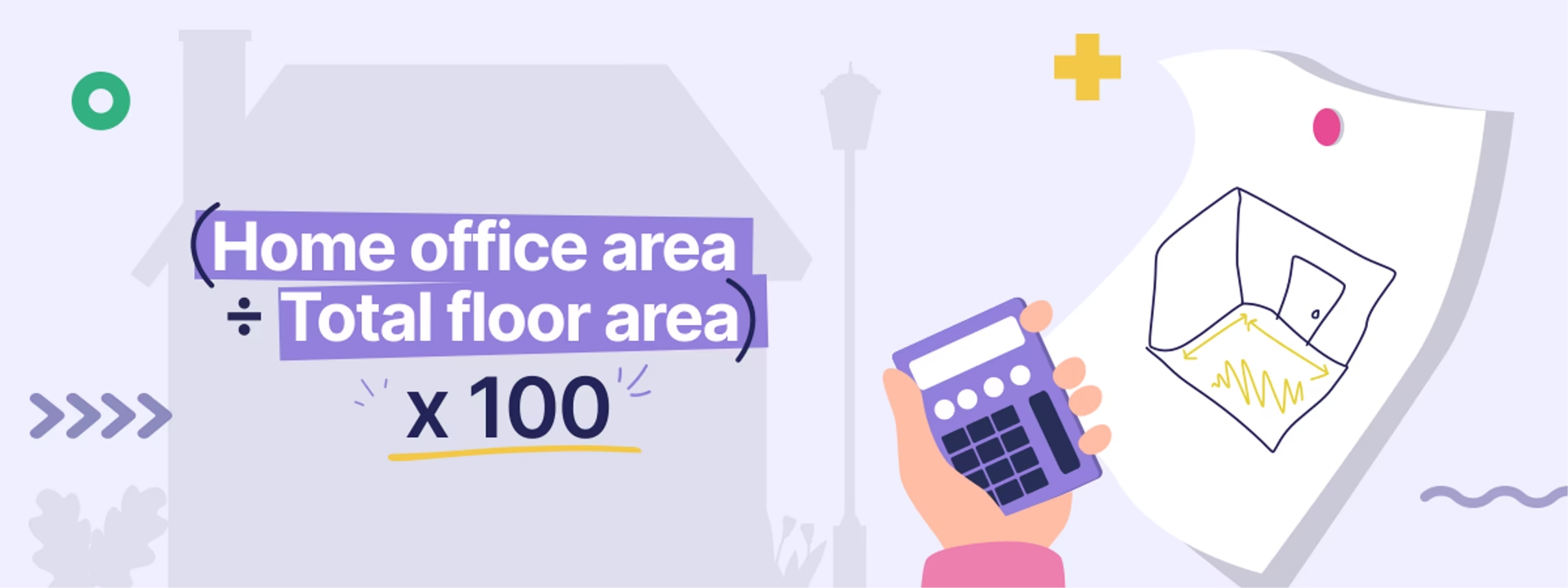
To work out the percentage of your home taken up by your dedicated home office, you’ll first need to know the total area of both your entire house and your home office.
Once you have these two numbers, you’ll need to divide your home office area by the total floor area of your house, then multiply the result by 100:
Hours spent working from home
If you don’t have a dedicated home office, you can work out the business-use portion of costs based on the amount of time you spend working from home. Bear in mind though that your calculation has to be fair and reasonable, and the ATO may ask to see how you worked out your claim.
Let’s say you work from your living room for five hours a week, using an air conditioner that uses 1 kW per hour. You pay 30c per kWh. To calculate your weekly claimable electricity for the aircon, you’d need to multiply the amount of energy used by the hours worked from home and the cost per kWh. So:

That’s $1.50 per week, or about $78 a year.
Voilà! Claim calculated!
💡 Remember – you can generally only claim additional running costs incurred because you’re working from home. If other household members would’ve had the lights/heating/cooling on anyway, those aren’t additional costs!
Record keeping for the actual costs method
To use the actual costs method, you’ll need to keep a record showing either:
- the total number of hours you’ve worked from home across the financial year, or
- the number of hours worked from home for a continuous 4-week period, representative of your usual work patterns
You’ll also need a record of:
- The additional running expenses incurred while working from home – think receipts and bills
- How you worked out the amount you’re claiming.
Again, you may need different records for any depreciating assets. For more information, visit the ATO website.
Expenses made easy with Hnry
We may be biased, but we believe that the best way for sole traders to maximise their tax deductions (legally) is to use Hnry.
Hnry is an award-winning tax service that’s helping sole traders spend less time on financial admin, and more time doing what they love (unless what they love is financial admin).
For just 1% +GST of your sole trader income, capped at $1,500 +GST a year, we calculate, deduct, and pay all your taxes, levies, and whatnot for you, including:
… meaning you won’t have to think about any of that. Ever. We’ll even lodge your tax return and BAS for you, whenever they’re due.
Raising expenses through our app is as simple as taking a photo of your receipt and inputting a few extra details. From there, our team of tax experts will manage your expenses, passing on any tax relief you’re eligible for in real time (rather than having to wait until the end of the financial year). Easy as!
Get your tax ducks (and deductions) in a row by joining Hnry today!